Enjoying a Pie to Celebrate the Reliability of the Holy Bible
The following is a guest post of Tom Sullivan, a retired engineer who is a member of the Lafayette Reformed Presbyterian Church of Lafayette, Indiana.
Among those interested in mathematics, March 14, which may be written as 3.14, is informally celebrated as Pi Day, frequently with home-baked pies.1 Interest in π goes way beyond its use as the ratio of a circle’s circumference to its diameter. In mathematics, physics, and other fields, it pops up in what appear to be the strangest places. Pi (π) itself is a fascinating number whose value has been computed out to over 300 trillion digits—digits that never repeat (such as 1/3= 0.333…) and that appear to be entirely random.2
In the popular press, science writers regularly claim that the Bible gives the value 3 for π based on a careless reading of 1 Kings 7:23-26:
Then he made the sea of cast metal. It was round, ten cubits from brim to brim, and five cubits high, and a line of thirty cubits measured its circumference. Under its brim were gourds, for ten cubits, compassing the sea all around. The gourds were in two rows, cast with it when it was cast. It stood on twelve oxen, three facing north, three facing west, three facing south, and three facing east. The sea was set on them, and all their rear parts were inward. Its thickness was a handbreadth, and its brim was made like the brim of a cup, like the flower of a lily. It held two thousand baths” (1 Kings 7:23–26 ESV).
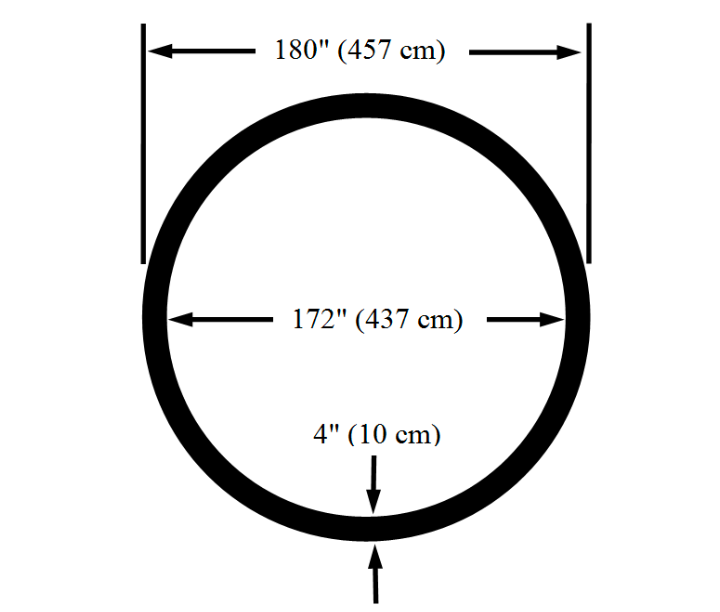
For simplicity, let us convert cubits to inches and centimeters, and circumference to diameter using an 18-inch (46 cm) cubit and 3.14159 for π. This gives us diameters of 180 inches (457 cm) and 172 inches (437 cm). Subtracting the latter diameter from the former, then dividing the difference by two, gives us 4 inches (10 cm), a perfectly reasonable value for a handbreadth. This is especially so if the thumb is included, or the portion of the hand at the first thumb joint is used. The above analysis holds true for other cubit lengths and hand sizes.
So we are told how much space the sea took up, its interior size, and how sturdily it was constructed. It is unsurprising that there are people who wish to discredit God and His holy Word and think to throw a π in God’s face, but only end up with egg on their faces.
1 The almost universal pronunciation of π (as a number) is “pie,” but most Greek scholars and students pronounce it as “pea.”
2 The randomness of the digits of π has not yet been formally proven.