New Bible Translation Removes "Begotten", omits Lord's Prayer Doxology, Questions Trinity, Doubts Virgin Birth
Advocates of the exclusive use of the King James Version celebrate William Tyndale. and yet unwittingly attack some of his translation choices as not only wrong, but heterodox (when they are followed by modern versions). In light of that, I thought it would be interesting to review Tyndale's 1526 Greek New Testament using the rhetoric, arguments, and language of King James Onlyism. Except in this case with the Wycliffe Bible, rather than the KJV, as the standard. (I also highlight some key differences between Tyndale and the KJV).
(I'll not get into the question of whether someone can in good conscience celebrate Tyndale while making Christians feel guilty about reading any English Bible translation produced in the last four centuries).
As Tyndale learnt to his cost on the morning of 21 May 1535, not all who claimed to be his friends actually were.
ST ANDREWS, SCOTLAND, 1526
Concerns are mounting about a new Bible translation being smuggled into Scotland, that has been produced on the continent by a Mr William Tyndale.
Tyndale is marketing a translation that even the ploughboy can read, but on closer inspection it seems that key doctrines have been removed in his "dumbed down" Bible.
Tyndale "introduces a contradiction into Scripture"
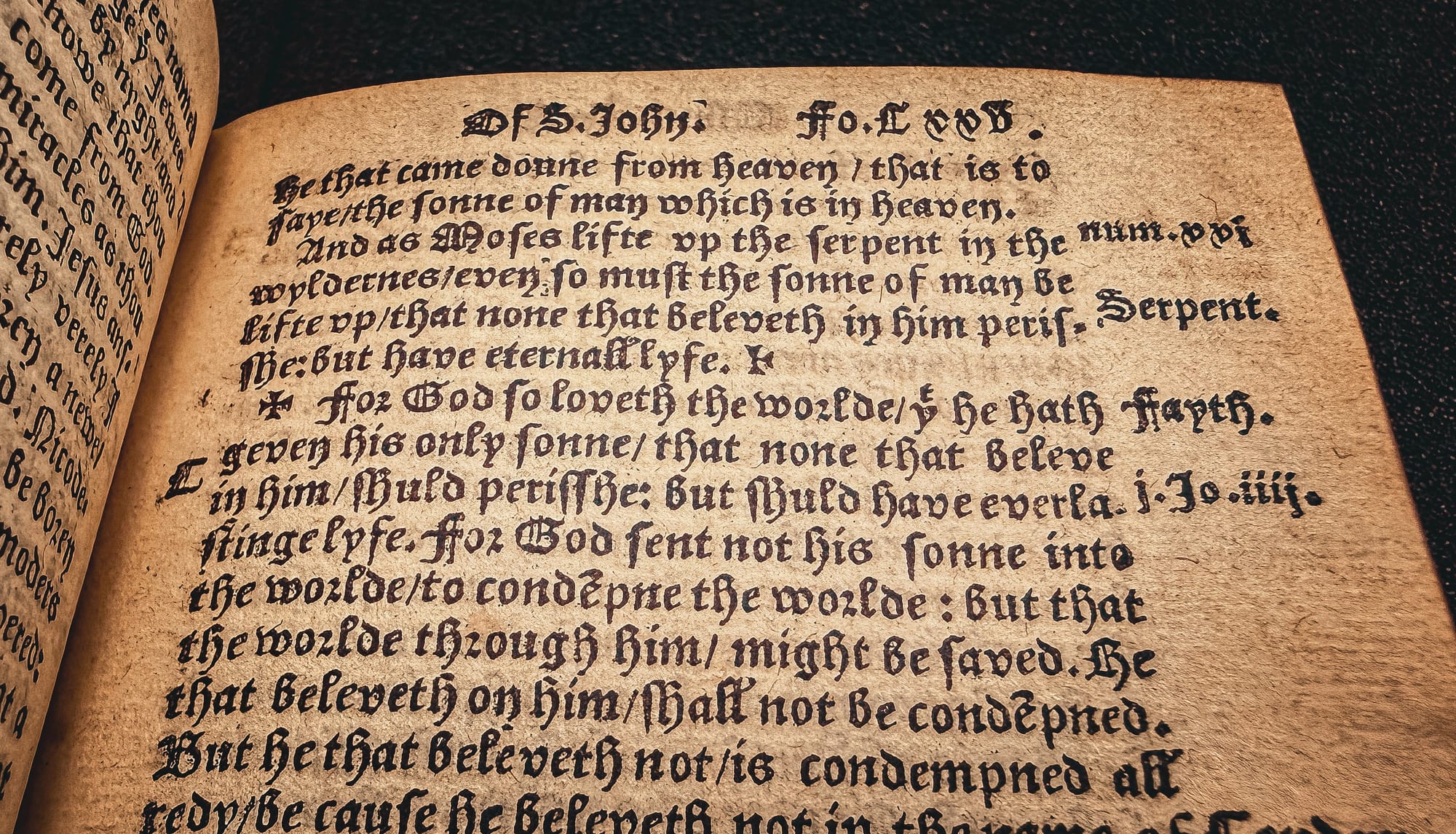
Shockingly, not even the most famous verse in the Bible is safe from Tyndale's meddling. Everyone knows that John 3:16, in our revered English translation (produced by John Wycliffe) reads as follows:
'For God louede so the world, that he yaf his oon bigetun sone, that ech man that bileueth in him perische not, but haue euerlastynge lijf.'
Yet Tyndale has taken a pair of scissors to the verse, with his perversion reading as follows:
'God so loved the world that he gave his only son for the intent that none that believe in him should perish but have everlasting life'.
The word 'begotten' has been removed — a clear attack on the doctrine of the eternal generation of the Son. Speaking from the unfortunately-named William Tyndale House, a representative of the Trinitarian Bible Society commented:
"It is an indication of the lamentable spiritual decay of these times that there are modern translations of the Scripture in circulation which, by an erroneous translation of μονογενης that omits the concept of ‘begotten’, effectively wipe out the exegetically well-founded theology found in the Nicene Creed and historic Reformed Confessions.
Tyndale's translation, influenced by anti-Trinitarianism, introduces a contradiction into Scripture:
...Modern translations of μονογενης ‘only Son’ ... actually introduce a contradiction into Scripture.
...It is an astonishing fact that a large part of the church today, by adopting modern Bible versions which omit the concept of ‘begotten’ in the translation of μονογενης, are being silently and unwittingly infiltrated with anti-Trinitarianism".[1]
Tyndale "casts doubt on the virgin birth"
Tyndale actually matches Wycliffe at Luke 2:33 in referring to Mary and Joseph as Jesus' "father and mother". Yet the TBS spokesman was keen to emphasise that translations which describe Joseph as Jesus' father — as many editions of the TR do — cast doubt on the virgin birth:
"Joseph’s association with Mary as ‘His father and mother’ tends to leave the reader with the impression that this special parentage was equally shared by this human couple. Thus the NIV, with its use of the United Bible Society’s text, casts doubt on the virgin birth of the Saviour."
One wonders whether the TBS will cast the same aspersions at the KJV, which describes Joseph as Jesus' father in Luke 2:48?
"Do we have a perfect proof text for the Holy Trinity?"[2]
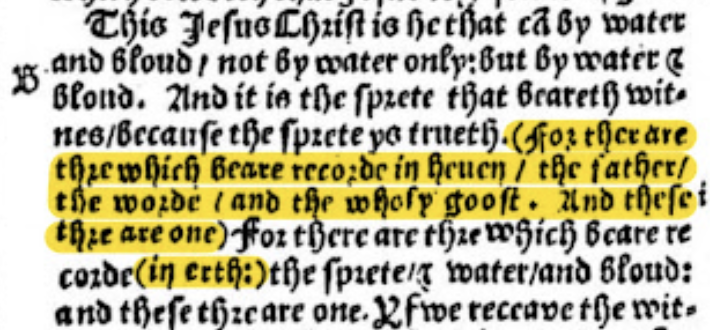
Those who believe in the Trinity might breathe a sigh of relief upon turning to 1 John 5:7-8 and seeing the Comma Johanneum intact. This is a particular relief, given that the editors of Tyndale's critical Greek text, the so-called Textus Receptus, don't believe these words are original, and didn't include them in their first two editions. Yet we can't rest easy: it is rumoured that Tyndale's upcoming revision will put these vital words in smaller type and enclose them in brackets — thus casting doubt on God's word.
Tyndale's Lord's Prayer ends with evil
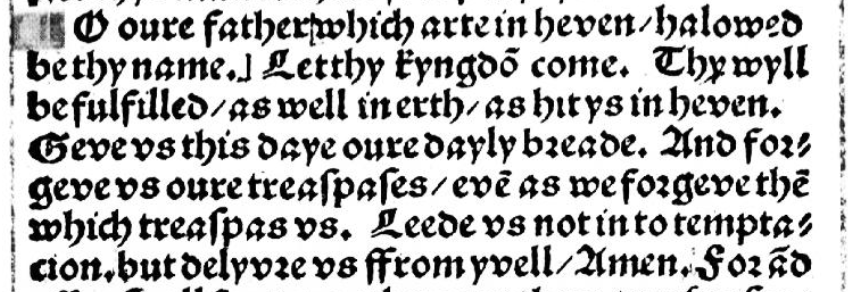
Sadly, one place where Tyndale does follow Wycliffe — and again departs from (most editions of) the TR — is in not including the doxology of the Lord's Prayer:
"Lead us not into temptation, but deliver us from evil. Amen."
And yet we know that the Lord's Prayer cannot end with evil. When questioned, Tyndale pointed out that the Lord's Prayer ends the same way in Luke's gospel, as if that was a valid excuse.
Those who follow modern translations such as Tyndale's (and, admittedly, Wycliffe's) are being misled. As one contributor to the infamous "Satan's Bible" book notes:
Children who are raised using modern versions based on the Critical Text may struggle to find this doxology in their Bibles!
Why do modern translators like Wycliffe and Tyndale do this? The TBS have surely hit upon the answer:
Is it because inwardly they know that this clause is genuine and they tremble at the warnings in Scripture not to take away words from the Word of God?
A Reconstructed Text Sponsored by the Vatican?
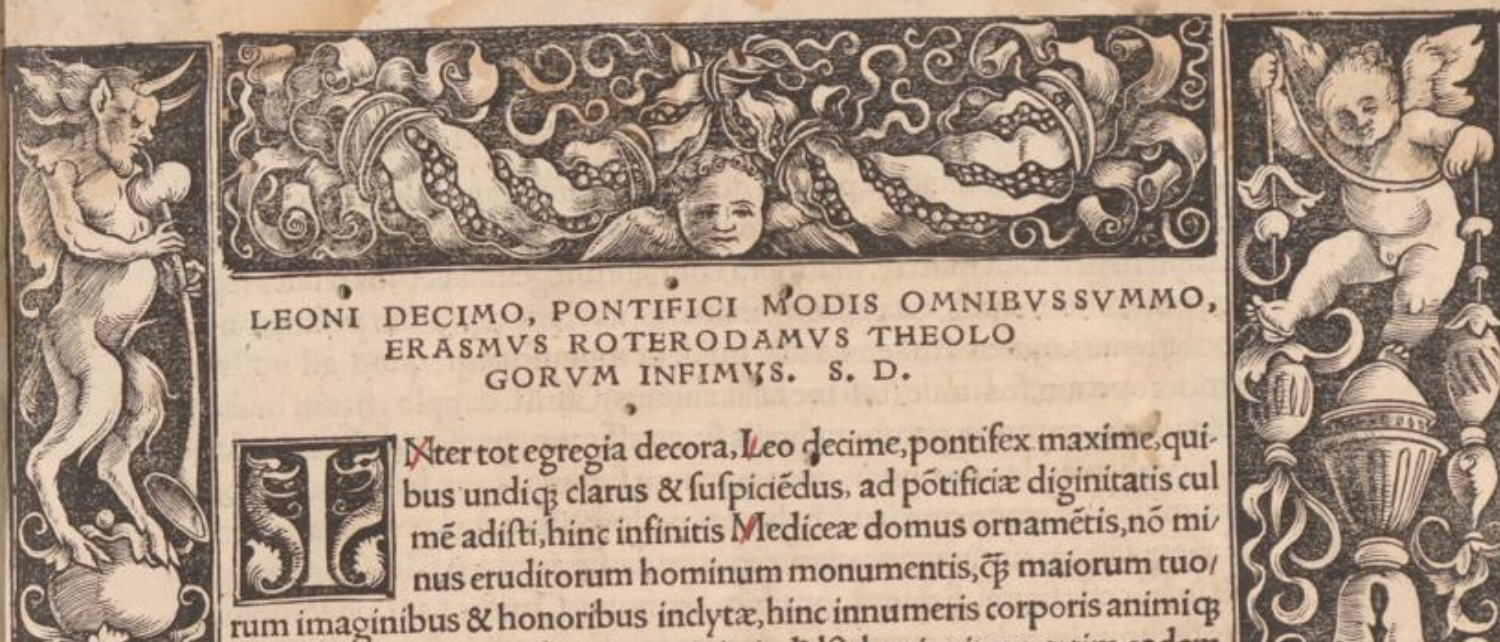
It is reported that some of the omissions in Tyndale's Bible are the result of his following a reconstructed Greek New Testament produced by an illegitimate Roman Catholic priest named Erasmus and dedicated to Pope Leo X, the Anti-Christ himself.
Any attempt to go back to so-called "older" and "better" Greek manuscripts to correct the Bible that the church has used for 1500 years flies in the face of passages such as Matt. 5:18 and Psalm 12:6&7.[3] Does Tyndale believe that God has preserved his word or not?
Furthermore, Erasmus has already produced three editions of his so called "Textus Receptus" in less than a decade, with a fourth slated for release next year. Which one, we might ask, is God's preserved and undoubted word?
Tyndale, too, is rumoured to be already working on future English translations, at which point his vaunted 1526 edition will become obsolete. How can he believe God's word has been kept pure in all ages if he keeps changing it? It couldn't be clearer that he's simply in it for the money.
Verses Removed
Such is his lack of respect for the Word of God, that at least one whole verse is removed from Tyndale's modernist Bible.
Luke 17:36 in our beloved Wycliffe translation, tells us that there will be "twei in a feeld, the toon schal be takun, and ‘the tother left". Tyndale removes this verse altogether, resulting in a weakening of our Lord's warning to be ready for his return.
Thankfully, the TBS are already sounding the alarm. Tyndale's missing verse is listed in a recently-published booklet under the title "Doctrines affected and altered". The author urges readers to try and look up these verses "in a modern translation", no doubt with modernists like Tyndale in mind. "Fair warning: you may not find them". The TBS writer urges:
"Read each of these verses in the KJV [does he mean Wycliffe?] and think about it: do these verses affirm any important doctrines? Would their deletion matter?"
When challenged about this, a friend of Tyndale defended him by saying that if he was really trying to remove text from Scripture, he wouldn't have included the missing words in Matthew 24:40, from where he claims they were wrongly inserted into Luke in a small minority of manuscripts.
Don't listen to their appeals to the "majority" however. As Jeff Riddle has rightly said:
"the Majority Text is not really a viable option for traditional Protestant Christians who hold to the providential preservation of the Word of God."
Jesus' Name Repeatedly Removed
One of the hallmarks of modernist Bible translations is the removal of the name of Jesus. The TBS have highlighted that: "In numerous places in the New Testament the name of Jesus is omitted from the Critical Text". Sure enough, one of the marks of Tyndale's version is the removal of the name of Jesus.
In Acts 10:48 in the traditional text of our Wycliffe Bibles, Peter commands that the Gentiles be baptised "in the name of the Lord Jhesu Crist". In Tyndale's modernist version, the words "Jesus Christ" are removed.
Another clear example of this is in Jude 5, where Wycliffe's version reads: "Jhesus sauyde his puple fro the lond of Egipt". In Tyndale, "Jesus" becomes "the Lord".
Again in Jude 25, Wycliffe reads: "to God aloone oure sauyour, bi Jhesu Crist oure Lord, be glorie, and magnefiyng". Yet in Tyndale, the words "by Jesus Christ our Lord" are missing.
It gets worse. Revelation 14:1 tells us that the 144,00 have "his name [ie the Lamb's] and his Father's name written on their foreheads". Yet in Tyndale's version, "his name" is removed, despite being in the vast majority of Greek manuscripts.
In Acts 16:7, we're told that Paul, Silas and Timothy attempted to go in to Bithynia, but "the spirit of Jhesu suffride not hem". In Tyndale's modernist version, the name of Jesus is again removed.
A clear pattern can be seen. We suspect it will be many centuries before Jesus' name is restored to these passages in English translations.
Christ's "spiritual and moral teaching damaged"
Not only is Jesus' name repeatedly removed by Tyndale, parts of his teaching are removed as well. At Matthew 5:22, Tyndale departs from the Textus Receptus by omitting the words "without a cause". He seems to have been influenced by the annotation of Erasmus who says:
it appears that it was added by some impudent person who wanted, as it were, to mitigate that which in general appeared to be a rather hard saying.
But what evidence does Erasmus have for that?! Listen to the TBS and reject such omissions in modern versions, since:
By omitting it, modern translations damage the spiritual and moral teaching of this part of Christ's discourse.
Dynamic Equivalence Denies Inspiration
Tyndale's use of dynamic equivalence shows that he does not believe every word is inspired.
For example, a literal translation of Genesis 47:8, as translated by Wycliffe, correctly renders Pharaoh's question to Jacob as: 'Hou many ben the daies of the yeeris of thi lijf?' Tyndale dumbs this down to: "How olde art thou?".[4]
Does he not believe every word is inspired?
(For a New Testament example, see the introduction of the name of "God" in 2 John 10 & 11, despite it not being there or even implied in the underlying Greek text).
As the TBS have warned in their documentary on Tyndale:
While this approach may appear to make the Bible easier to read, it actually disconnects readers from the original Greek and Hebrew and leaves them with subjective meanings. This approach is built on assumptions that diverge from the traditional view that every word of scripture is inspired.
Bible translators who use it are influenced by "secular linguists" who "often viewed language as a mere product of human evolution".
These theories fail to acknowledge God as the creator of language and the divine author who inspired every word of scripture, transcending culture and time. As a result, dynamic equivalence measures accuracy by the subjective experience of the reader, rather than by how faithfully the precise words given by God are rendered.
We have it on good authority that the literal translation of Wycliffe at Genesis 47 will not be restored even in the proposed King James translation of 1611, and that we will have to wait until the English Revised Version of 1881 and the ESV of 2001 until this verse is rendered properly again.
Conclusion
If the ploughboy wants to read the Bible, he should stick to our tried and trusted English version, and if he can't understand it, he should buy a dictionary.
"Axe ye of elde pathis, which is the good weie; and go ye ther ynne, and ye schulen fynde refreischyng to youre soulis" (Jeremiah 6:16).
What can be said of another modern translation can surely be said of Tyndale's: "although it contains truth, is it the very Word of God? If not, Christians must be urged to return to the truth".
The publication of a Bible version which removes the word begotten, casts doubt on the virgin birth, contains a truncated version of the Lord's Prayer, and damages Christ's teaching in the Sermon on the Mount is no cause for celebration.
- Obviously the TBS article doesn't include Tyndale in their attacks. But surely to be consistent, they should? His was the first English translation to 'remove' the word begotten.↩︎
- The question is asked on p. 131 of Jeffrey T. Riddle and Christian M. McShaffrey (eds),Why I Preach from the Received Text (Winter Springs, FL: 2022).
- Erasmus's dedication to the Pope says that he used manuscripts that are "both very old and very correct" (trans. Alexander Dalzell in CWE 41, 770).↩︎
- To be strictly historically accurate, Tyndale's translation of the Pentateuch wasn't published until 1530. But I'm not planning to review it separately!↩︎