Unpicking a Misleading Meme on Mark 16 (Part 2)
A continued analysis of four images posted to social media by the Trinitarian Bible Society. Once again, I won't argue either way as to whether Mark 16:9-20 was originally part of the Biblical text. My concern is about method, not conclusions.
"A tiny minority" ... "99% of surviving manuscripts"
Here we get to the fatal flaw of the whole KJV/TR movement — their refusal to apply this consistently. They will use majority arguments when it suits them, and then turn round and ignore every single Greek manuscript when the manuscript evidence is inconvenient.
The fact that 99% of surviving manuscripts contain Mark 16:9-20 is a pretty good argument that it's original.
But surely we would expect KJV/TR defenders to be consistent, and reject other minority readings? And certainly to reject readings with no Greek manuscript evidence whatsoever?
What if there was a reading only found in 50% of surviving manuscripts? What about 25%? What if it was in 0% of Greek manuscripts? What if it's clearly a printing error, such as the omission of "God" in the TR at Revelation 1:8? What if it's text accidentally copied from a commentary, as at Rev. 21:24? What if Erasmus himself tells us that he backtranslated a reading from the Latin Vulgate because his manuscript was incomplete?
The answer is that it makes no difference to them. Indeed, it's hard to see any mention of manuscripts by TR defenders as anything other than a red herring.
What those who see this meme — and are perhaps inclined to distrust their Bible translation as a result — need to realise is: TR defenders only appeal to the majority of manuscripts when they support the KJV.
When the manuscripts support their position, they will argue from the manuscripts. When the manuscripts don't support their position, they will argue against the manuscripts. Indeed, a defence of Theodore Beza's conjectural emendation at Revelation 16:5 (added briefly to the TR then removed again) on the TBS sermonaudio page says that those who don't accept it have a carnal mind.
So the same people who will argue from the manuscript evidence when 99% of it agrees with the KJV — will call people unbelievers if we don't reject 100% of the manuscript evidence when it doesn't support the KJV.
Go back one chapter in Mark to see that all that really matters to the TBS is the KJV
There is no consistency — other than to what the KJV says.
Or at least — to the 19th century Greek TR made to reflect the translation choices of the KJV. For an example of that, go back one chapter in Mark to Mark 15:3. The KJV adds "but he answered nothing". What is that based on? The TR editions of Erasmus? Stephanus? Beza? Elzevir? Some other "mature Protestant" Textus Receptus? The Majority Text? The Byzantine Text? Not at all. It's the Complutensian Polyglot, and the second edition of the Bishop's Bible. It's not in Wycliffe, Tyndale, the Geneva Bible, or the first edition of the Bishop's Bible. But Scrivener's TR contains it, because it was designed to match the KJV. [1]
And yet according to the TBS, this is one of the places where "the modern versions have followed corrupted manuscripts and made drastic alterations to the traditionally accepted text of the New Testament". This is nonsense. What the TBS call an "omission" isn't in almost all TRs and isn't in the Majority Text. It was crossed out of the copy of the Bishop's Bible used by one company of the KJV translators, and so would have been rightly left out if that call hadn't been overruled. And yet it's on a list that seeks to show "the many and most serious omissions in the modern editions of the New Testament".
The TBS are simply starting with the KJV, noting where other versions differ, and condemning them. The reason is nothing to do with manuscripts, it's simply because every other English version today differs from the KJV (other than those based on a TR edition compiled in 1881 to match the KJV).
They both appeal to the majority and attack the majority
If what mattered to them was what the majority of extant manuscripts said, they would hold a Majority/Byzantine position. Yet they do not. And (some of) their leaders realise this, even if many of their adherents do not. According to Jeff Riddle: "the Majority Text is not really a viable option for traditional Protestant Christians who hold to the providential preservation of the Word of God". A TBS booklet seeks to highlight "the manifold problems in the modern Byzantine Majority Text".
(The use of the word "modern" when applied to the Byzantine text is a bit of a misnomer. And if the author has problems with the modern majority text, perhaps he should instead appeal to the majority of manuscripts in the early centuries of the church, mentioned by Jerome and Eusebius, which finish Mark 16 at verse 8?)
So you can safely ignore any TR memes which appeal to the majority. Their argumentation shows that the only question they're really interested in is "what does the KJV say?" (A few of them may occasionally consider other TR readings if you really push them — but certainly not the exclusion of 1 John 5:7-8 or the Lord's Prayer doxology, both of which are omitted in certain TR editions — even if Riddle claims "There is no disagreement in the TR tradition on ... the CJ").
For an example of the fatal inconsistency of the KJV/TR position, see the two 2020 debates between James White and Jeff Riddle (Riddle has authored a booklet for the TBS on John 7:53-8:11 and is often cited by them).
In the first debate, Riddle argued from the manuscript evidence in favour of the longer ending of Mark 16 — and then against the manuscript evidence in favour of 'fellowship' in Ephesians 3:9 in the second. How many manuscripts support 'fellowship'? Just one — from the 11th century. But the KJV (and most printed TR editions — but not the Complutensian Polyglot) have it, so Riddle must argue for it.
(The reader who's paying attention will note that this is the opposite situation from Mark 15:3. In both places, the Complutensian Polyglot differs from every other (significant) C16th/17th TR. At Mark 15:3, the Complutensian is followed over against every other TR. At Eph 3:9, every other TR is followed over against the Complutensian. Why is the Complutensian followed in one place and rejected in another? Three letters — KJV.)
An English translation from 1611 is the standard by which everything else is weighed and found wanting.
Rewriting History
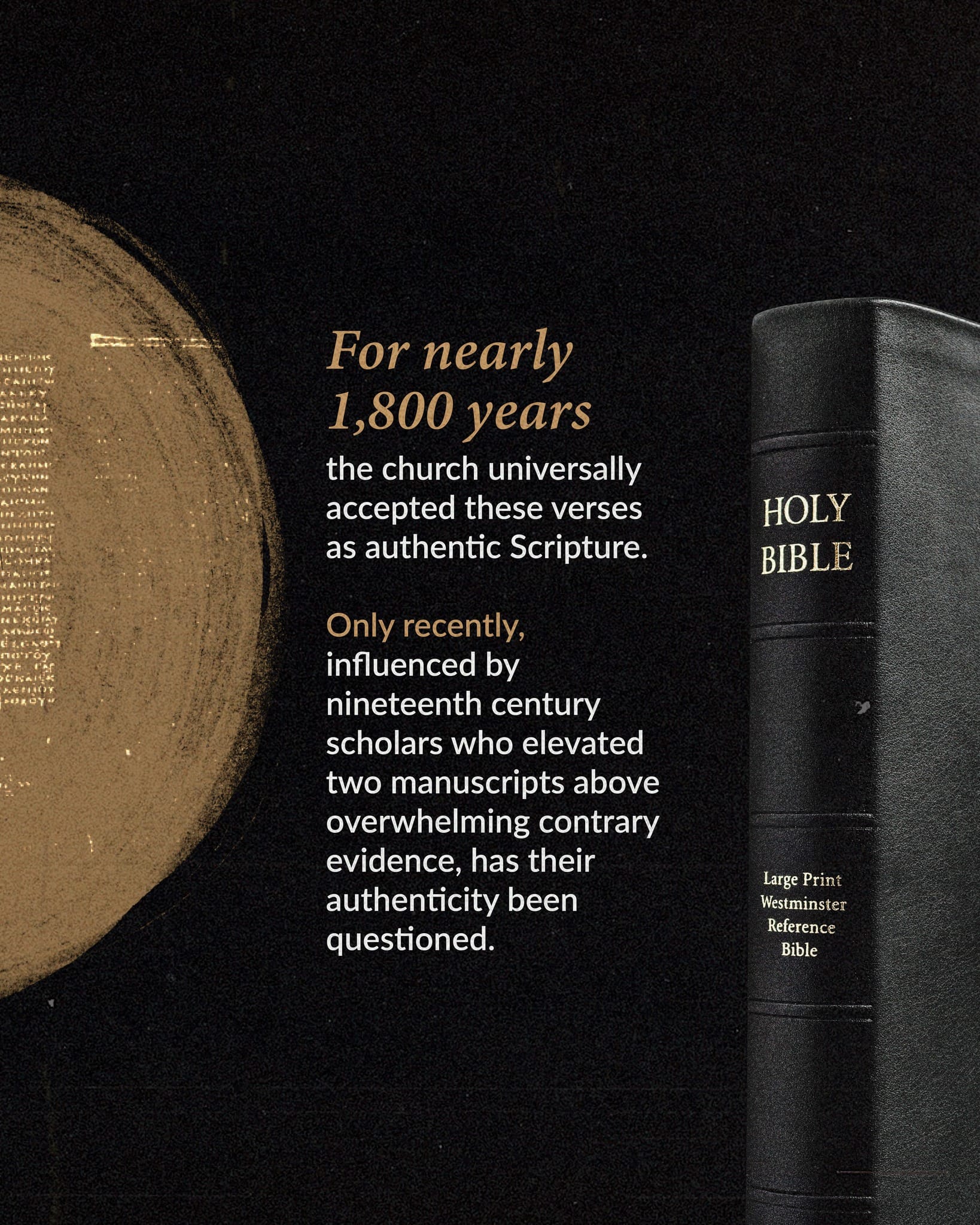
How could the church have "universally accepted" verses which many of them didn't even know about?
As Philip Comfort explains:
Of the church fathers, Clement, Origen, Cyprian, and Cyril of Jerusalem show no knowledge of any verses beyond 16:8. Eusebius said that the accurate copies of Mark ended with verse 8, adding that 16:9–20 were missing from almost all manuscripts ... The pericope is also absent from the Eusebian canons. Jerome affirmed the same by saying that almost all the Greek codices did not have 16:9–20 ... Several minuscule manuscripts (1, 20, 22, 137, 1216, 1582) that include 16:9–20 have scholia (marginal notes) indicating that the more ancient manuscripts do not include this section.
Other manuscripts mark off the longer reading with obeli to indicate its questionable status. The textual evidence, therefore, shows that Mark’s gospel circulated in many ancient copies with an ending at verse 8. [2]
It's fine to argue that the Longer Ending of Mark is canonical. But let's not pretend that all Christians everywhere ("the church universally") accepted verses which many of them had never seen.
If by "the church" the TBS mean some sort of pronouncement on the authenticity of these verses, the first would seem to be the 16th century Roman Catholic Council of Trent, which on 8 April 1546 pronounced anathema on anyone who didn't receive as canonical the books contained "in the old Latin vulgate edition...entire with all their parts".
"For nearly 1800 years"
Even if this were true, Scrivener didn't see that as a reason to keep text which wasn't originally there
This is how Scrivener, the editor of TR that the TBS reprint, describes the work of textual criticism:
"By collecting and comparing and weighing the variations of the text to which we have access, it aims at bringing back that text, so far as may be, to the condition in which it stood in the sacred autographs; at removing all spurious additions, if such be found in our present printed copies; at restoring whatsoever may have been lost or corrupted or accidentally changed in the lapse of eighteen hundred years….Those who believe the study of the Scriptures to be alike their duty and privilege, will surely grudge no pains when called upon to separate the pure gold of God’s word from the dross which has mingled with it through the accretions of so many centuries." [3]
Why do they not apply this to other parts of the TR?
Here also the TBS post is misleading. Because surely it implies that they would reject any text that had not be seen by anyone until relatively recently in church history? Their key concern, however, seems to be with one particular year in church history: 1611.
Revelation 16:5
In 2021, the Quarterly Record of the TBS contained the following announcement:
Preparation for an important article on the textual question of Revelation 16.5 has been underway for some time now. The Received Text at Revelation 16.5 contains the triadic declaration ‘which art, and wast, and shalt be’, whereas the Critical Text substitutes the last member of that expression with ‘O Holy One’, thus setting the verse at odds with other parallel declarations found in the Book of Revelation (1.4, 1.8, 4.8, and 11.17)
As is typical, the statement of the situation is extremely misleading.
The Critical Text — and the Byzantine/Majority Text — follow the Greek manuscripts and have the word "holy". As do the majority of TR editions! The "triadic declaration" — to be specific "and shalt be" — is not in any Greek manuscript of Rev. 16:5.
It was very briefly in the Textus Receptus, but there is no manuscript evidence for it in any language. Beza simply thought it should be there (and made a note to that effect, which he later mistakenly thought constituted manuscript evidence).
TR editions before his time don't have it. TR editions after his time don't have it (other than Scrivener, which was reverse engineered from the KJV — and Elzevir 1633, where it was added, and then removed again in their final five editions). Even Edward Hills, in The King James Version Defended, acknowledges that "Beza introduced a few conjectural emendations into his New Testament text", but that "in the providence of God, however, only two of these were perpetuated in the King James Version". One of the two that Hills acknowledges was "and shalt be" at Revelation 16:5. [4]
So no Christian in history had seen "and shalt be" at Rev. 16:5 until Beza's third TR edition in 1582. It was removed by later editors in a 1611 TR published at Geneva after his death. It was in the Elzevir edition of 1633, but removed again in the next edition, eight years later, and onwards.
It wasn't in the Bibles of Wycliffe, Tyndale, the Geneva Bible, or even the Bishop's Bible, which the KJV was a revision of.
And so to modify the language of the TBS image above and apply it to this passage:
"For nearly 1600 years, the church universally accepted Revelation 16:5 — without the phrase "and shalt be" — as authentic Scripture.
Only recently, influenced by an editor who thought the existing TR was wrong, was this phrase introduced.
And yet because this conjectural emendation made it into the KJV, the TBS are prepared to defend it, despite overwhelming contrary evidence".
Why will they defend "and shalt be" in Revelation 16:5 even though it isn't in almost all TR editions? Quite simply because it made it into the KJV.
A strong case for the Longer Ending of Mark 16 can be made by appealing to the majority of manuscripts. But apply that same argument elsewhere, and it would lead to the rejection of parts of the TR/KJV.
Footnotes
[1] According to Michael Marlowe's helpful (though incomplete) list of Variations within the Received Text Tradition it is contained in Stephanus's first two editions, but not his most significant one of 1550. Backus surmises that the KJV translators kept the phrase because Beza noted it was in the Complutensian Polyglot and commented: "this appears to fit very well with the things that are set down next" (even though he didn't include it in any of his own editions). See Irena D. Backus, The Reformed Roots of the English New Testament: The Influence of Theodore Beza on the English New Testament, ed. Dikran Y. Hadidian, The Pittsburgh Theological Monograph Series (Eugene, OR: Pickwick Publications: An Imprint of Wipf and Stock Publishers, 1980), p. 75.
[2] Philip W. Comfort, New Testament Text and Translation Commentary: Commentary on the Variant Readings of the Ancient New Testament Manuscripts and How They Relate to the Major English Translations (Carol Stream, IL: Tyndale House Publishers, Inc., 2008), p. 159.
[3] Frederick Henry Ambrose Scrivener, A Plain Introduction to the Criticism of the New Testament, ed. by Edward Miller, Fourth Edition (London; New York; Cambridge: George Bell & Sons; Deighton Bell & Co., 1894), i, 5.
[4] Edward F. Hills, The King James Version Defended, p. 161.