Conclusions: The TBS, the Textus Receptus, and Franz Delitzsch
In my first two posts, I have analysed a series of four images from the Trinitarian Bible Society about Mark 16.
I have pointed out some statements that are misleading and others that are simply wrong — both in the images themselves, as well as in various TBS publications.
I have also sought to show that if the Majority Text arguments used by the TBS at Mark 16 were applied to the rest of Scripture, various parts of the Textus Receptus would need to be changed.
The biggest problem with the TBS's arguments in favour of the Longer Ending of Mark 16 is their refusal to apply them consistently.
Ultimately, however, I realise that for most people, what they believe about Bible translations comes down to who they trust.
And so for this concluding post, I want to appeal to someone who the TBS promote as "The German With a Love for the Jews" — and are soon to release a documentary about.
Don't take my word for it — listen to Franz Delitzsch — promoted by the TBS even though he dealt a "considerable blow to the TR"
The TBS have indicated that they are soon to release a documentary about the German scholar Franz Delitzsch. And yet Delitzsch was no more an advocate of the TR than Scrivener. As Krans comments: "Delitzsch has no high opinion of the history of the Textus Receptus". According to Delitzsch, "The history of the New Testament text is a sorry tangle of poor scholarship, charlatanism, and printers’ puffery". [1]
Indeed, Delitzsch's rediscovery of the manuscript of Revelation used by Erasmus, and his meticulous description of Erasmus’ treatment of the text, "must have been a considerable blow to the Textus Receptus". [2] Delitzsch has a whole appendix entitled "The Readings Invented by Erasmus and their alleged manuscript attestation". [3] His first volume is subtitled: "The Erasmian Corruptions of the Text of the Apocalypse, Demonstrated from the Long-Lost Codex of Reuchlin". [4]
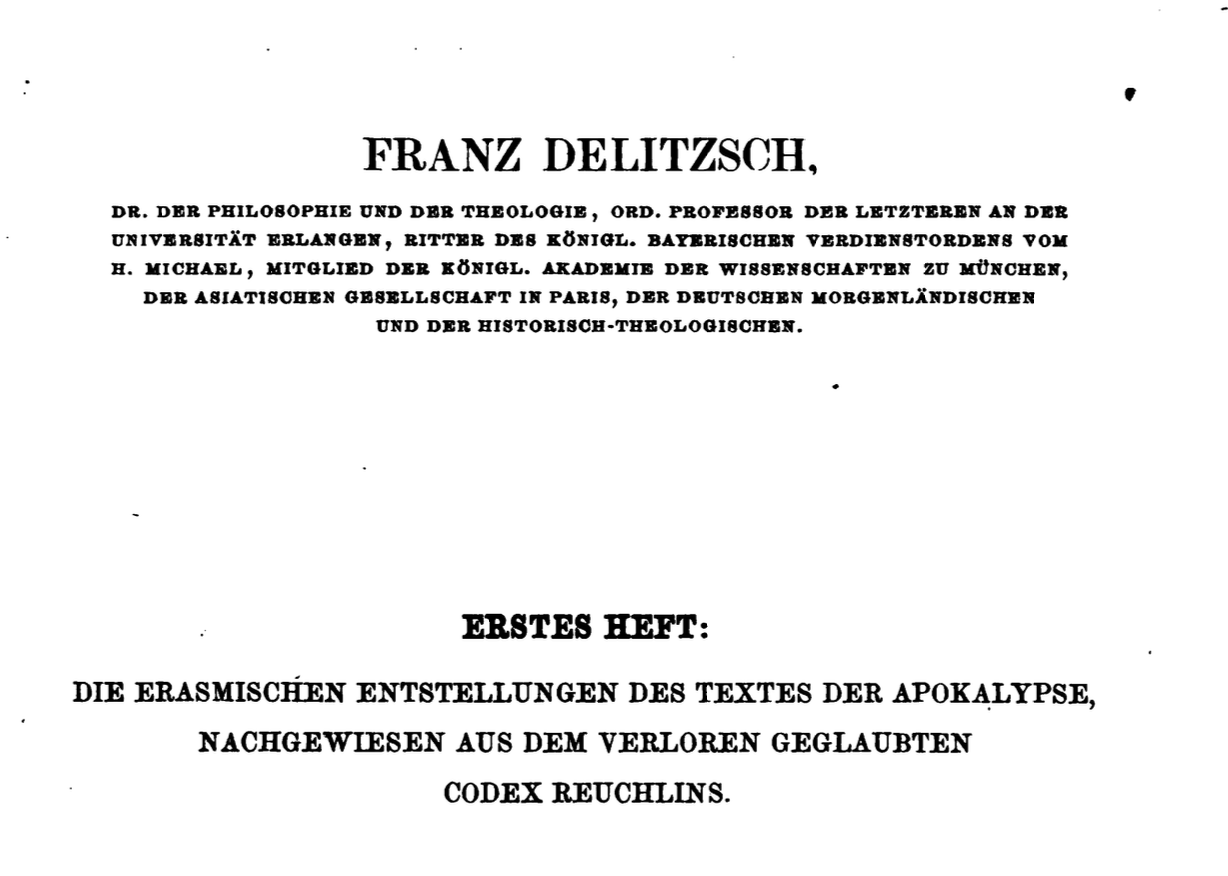
In it, Delitzsch stated his desire to "free the traditional text of the Apocalypse and the criticism of its text from many handed-down inaccuracies" as well as to provide evidence that the Lutheran Bible of his day (and — by implication — any TR translation) "require[d] manifold correction". In short, in the book of Revelation "readings persist of which [Erasmus's] conscience must have told him were abandoned by all manuscript evidence" — they were nothing less than "highly clumsy inventions of Erasmus". It is "full of errors and interpolations", often because Erasmus found that words and phrases he knew from the Latin Vulgate were absent in the Greek, and so he "frequently changed the text of the manuscript according to the Vulgate". [5]
Indeed, as Krans puts it in the video linked below, in the case of Revelation, Erasmus:
really had something to hide. Full exposure of what he had done to his Greek text would have invalidated the text-critical foundation of his work, and endangered his entire New Testament project.
What Erasmus hid, however, Delitzsch discovered. Therefore I hope that those who watch the forthcoming TBS documentary will learn that 165 years ago, in his own words, Delitzsch:
establish[ed] with irrefutable certainty that Erasmus, when he made the text of the Apocalypse ready for printing for the 1516 edition, had only the transcript of the Codex before him without comparing it with the original; that the copyist misread it in many places and allowed other inaccuracies and errors of haste to occur ... in short that he gave to the textus receptus of [Revelation] a foundation whose defectiveness and arbitrariness and unreliability have been of grievous consequences (emphasis added) [6]
Indeed even Edward Hills, in The King James Version Defended is willing to acknowledge that "the work was performed so hastily that the text was disfigured with a great number of typographical errors". While Delitzsch would take issue with Hills' claim that today there are only a "few typographical errors which still remain in the Textus Receptus of Revelation" — note that even Hills is willing to admit errors in the TR. It is not jot and tittle perfect. [7]
Another TR error that Hills acknowledges ("seems to be a misprint") is in Revelation 17:8. [8]
As Delitzsch explains:
It is Erasmus’ fault that Luther’s translation: ‘the beast that was and is not, although it yet is’ (Rev. 17:8) reproduces a text which rests only upon a misreading; it is his fault that New Testament textual criticism down to the present day registers readings invented by him as though attested by manuscripts, because he never openly declared what he had found and what he had corrected into the text; it is his fault that exegesis down to the present day discusses and expounds supposedly ancient variants which only in the years 1515/16 at Basel slipped into the text of the Apocalypse. [9]
Erasmus famously had little regard for Revelation. He tells us himself that he did with it what "I would not have dared to do in the Gospels nor indeed in the apostolic Epistles". [10] He only had one manuscript of Revelation. Indeed, according to Deltizsch, Erasmus was working off a (poorly-done) transcription of it, rather than the manuscript itself. In either case, it was missing the final verses of Revelation. And so — as Erasmus openly acknowledged — he back-translated them into Greek from the Latin Vulgate.
As Scrivener summarises:
As [his manuscript] was mutilated in the last six verses, Erasmus turned these into Greek from the Latin; and some portions of his self-made version, which are found ... in no one known Greek manuscript whatever, still cleave to our received text. [11]
Other errors (and Latin Vulgate readings introduced without Greek manuscript support) in Revelation include the following (with Delitzsch's comments):
Revelation 1:8
According to the TBS, the absence of the word "God" in the TR of Revelation 1:8 is an "Alteration in Modern Versions". [12] In reality, the word is omitted in the Textus Receptus because Erasmus (or his printer) made a mistake in 1516 and, while it was printed in the Latin text of his TR, it was left out of the parallel Greek column.
Delitzsch explains: "It is without manuscript support ... and Luther's translation [he would have said the same of the KJV if he was writing in English] ... is based solely on a reading error". [13]
One of the TBS booklets referred to in Part 1 asks: "Does it matter if the word ‘God’ is deleted from 1 Timothy 3.16?
(As usual, the reader isn't told the full story. The word "God" isn't there in Wycliffe's translation, or in the Latin Vulgate which was used by the church for 1000 years. It was included in the Textus Receptus — even though its first editor didn't believe it was original (despite TBS claims to the contrary highlighted in Part 1) —but once again is not present in modern editions. Over 150 years, the great Free Church of Scotland theologian Patrick Fairbairn could say: "The controversy so long waged about the correct text in this passage ... may now be regarded as virtually settled" (against "God" being the original reading). [14]
But we might well ask: "Does it matter if the word "God" is deleted from Revelation 1:8?"
There are (important) Greek manuscripts without "God' at 1 Timothy 3:16. There are zero Greek manuscripts which omit the word "God" in Revelation 1:8. It is once again clear that what matters to the TBS is not the manuscripts, but whatever made it into the KJV.
Other Erasmian corruptions highlighted by Delitzsch
Very briefly, here are some of Delitzsch's other comments on a small selection of Erasmus's additions to (and occasional subtraction from) the Greek text of Revelation. Examples could be multiplied. None of them are in the Majority/Byzantine or Critical Text.
1.11 - Removal of "seven". Addition of "which are in Asia".
'Erasmus has discarded the Codex’s ἑπτά — “seven” — and the words ταῖς ἐν ἀσίᾳ — “which are in Asia” — do not stand in the Codex, but are a patch by ER. based on the Vulgate’s quae sunt in Asia — “which are in Asia.” [15]
(The TR today still has the additional words taken from the Vulgate. However the "seven", discarded by Erasmus, is in the KJV (and hence Scrivener's TR), even though it's not in the TRs of Erasmus, Stephanus, Beza or the Elzevirs. It is, however, in the Complutensian Polyglot. Indeed Scrivener comments: "The marked inferiority of Stephens’ [Stephanus'] text in the Apocalypse will be seen to arise from his following Erasmus in preference to the Complutensian throughout that book". [16]
5:14 - the number 24 is "an Erasmian interpolation".
- The phrase "him that liveth for ever and ever" is "patched in from the Vulgate". [17]
14.5: The recently published Textual Commentary on the Greek New Testament (a companion volume to the UBS 6) says:
the Textus Receptus appears to incorporate a phrase from the Clementine Vulgate in ἄμωμοι γάρ εἰσιν ἐνώπιον τοῦ θρόνου τοῦ θεοῦ (‘for they are blameless in the sight of the throne of God’) [18]
Delitzsch agrees: The words after "blameless" are "an echo of Erasmian arbitrariness". [19]
16.5: Beza's conjectural emendation at Rev. 16:5 gets so much attention, that fewer notice that Erasmus inserted the word "Lord" (or "O Lord") into the Greek text from the Vulgate. According to the TBS, not including "O Lord" is one of the "more serious omissions or doctrinal problems" with modern versions.
Yet as Delitzsch points out, Erasmus's manuscript simply reads "You are righteous", rather than "you are righteous, O Lord". [20]
But I guess if the KJV is your standard, then it doesn't matter if the extra words weren't in Erasmus's manuscript, or indeed any other manuscript.
The Greek manuscripts do not matter to the TBS.
If all you have are Greek manuscripts, you cannot produce the Textus Receptus.
20.12: Delitzsch confirms that Erasmus, in fact, correctly followed his manuscript here. But I include this as more evidence that the majority of manuscripts means nothing to the TBS, unless those manuscripts support the KJV.
The KJV reads "before God". But as the NKJV footnote tells us, the Majority Text and the Critical Text both say "before the throne".
The TBS website says:
By substituting the impersonal ‘the throne’ for the name ‘God’ in this verse, the NIV and ESV obscure the Divine glory and honour belonging to Christ. [21]
And yet over 90% of Greek manuscripts have "throne" (as does Wycliffe's Bible). "Throne" is even there in the Complutensian Polyglot, counted on the TBS website as an edition of the TR, and which an article elsewhere on the TBS website says was used by Erasmus to "make improvements" to the first three editions of the TR. Those "improvements" included adding "throne" to the margin of Erasmus's later editions. And yet modern versions which follow the vast majority of Greek manuscripts and have "throne" in the text are accused of obscuring the divine glory of Christ! [22]
(Tragically, if the vast majority of Greek manuscripts are right and John originally wrote "throne" — and if to use the word "throne" rather than "God" is really to obscure the divine glory of Christ — then the TBS would be accusing the Holy Spirit of obscuring the divine glory of Christ).
Do you see the inconsistency from the same people who argue for Mark 16:9-20 on the basis of 99% of manuscripts? The omission of "God" at Revelation 1:8 is defended, even though there's no Greek manuscript evidence. Here, the insertion of "God" is defended, again in the face of the Greek manuscript evidence.
The only consistency is to the KJV. Similar examples could be multiplied.
21.2: "I, John": In the words of Andrew Brown (no advocate of the Critical Text): "Erasmus has created this part of his Greek text by retranslating from the late Vulgate". [23]
Delitzsch agrees: "The words ἐγὼ ἰωάννης εἶδον [I John saw], Erasmus has inserted against the testimony of the Codex from the Vulgate". [24]
21.14: The number 12 should appear 3 times, as it does in the Greek manuscripts and the Vulgate. Delitzsch notes: "The Vulgate also has duodecim [twelve], but Erasmus, because one of them must have appeared tautological to him, refrained from [including] it." [25]
Therefore the number only appears twice in the TR - simply because Erasmus thought twice was enough! Even though it appeared three times in the one manuscript of Revelation that he had.
21.24: Famously, words from a commentary by Andreas ended up in the TR, and as a result, the KJV.
Delitzsch comments: "this [reading] is without any manuscript attestation, and ... rests on the now-unveiled confusion of the words of Andreas and of the Apocalyptist in the Cod. Reuchlini." [26]
(There are a handful of other manuscripts that follow the same error. Hoskier — quoted positively in the "Satan's Bible" TR book — introduces one of them by saying:
"As regards xxi. 24 it is well-known that Erasmus took the commentary reading for his text, and left the real text in the commentary. It is not surprising, as the two sentences are conjoined." [27]
Conclusion
Much of the debate in Reformed circles, when it comes to textual criticism, involves newly discovered manuscripts. Should we change our Bible translations based on them? (The Westminster Divines, as I have argued elsewhere, would likely have said "yes").
For Franz Delitzsch, soon to be featured in a TBS documentary, the significant discovery was of the one Greek manuscript used in the production of the Textus Receptus of Revelation — and the shocking realisation that the TR departed from it in many places, for no good reason. According to Delitzsch, the "harmful consequences" of Erasmus's tinkering "extend even to this day into all translations resting on the textus receptus". [28]
As Delitzsch notes, quoting Bengel: "To cut away such additions, once fear is laid aside, is pious". [29] For the TBS, however, such additions must not only be kept, they must be defended. They can argue on the basis of the majority of Greek manuscripts for Mark 16:9-20 — but not for Beza's conjectural emendation at Revelation 16:5. Or Erasmus's insertion of "O Lord" in the same place. Or the absence of "God" in Revelation 1:8. Or the insertion of "God" at Revelation 20:12. Or the insertion of words from a commentary at Revelation 21:24. Or the additions to 1 John 5:7-8, and many other insertions which Scrivener — kept in print by the TBS — describes as the TR's "grosser corruptions".
Who then has the greater reverence for Scripture? The TR advocate who defends Latin Vulgate readings which Erasmus inserted into the Greek text of Revelation — a book he didn't believe was written by John and questioned whether it should be in the canon — or the Majority or Critical Text advocate who shows their commitment to the Greek manuscripts by either counting or weighing them?
Ultimately, what matters to the TBS — as they consistently demonstrate — is not the Greek manuscripts, but the KJV (or the 19th-century Greek text produced to match it). A meme that appeals to Greek manuscript evidence is therefore misleading, because they cannot and will not use the same arguments in other places. Indeed, they will attack the majority reading of the Greek manuscripts as "obscuring the Divine glory and honour belonging to Christ".
Video Resources
My Textual Criticism Articles
2025:
"Garnishing the Sepulchres of the Righteous": Textual Criticism in the Free Church Fathers (Foundations)
2023:
The Westminster Divines and the Alexandrian Codex (Foundations)
Reading the Confession in Context (1): Authentical (Gentle Reformation)
2022:
Textual Confidence (Gentle Reformation)
Footnotes
[1] Jan Krans, Beyond what is written: Erasmus and Beza as conjectural critics of the New Testament (Leiden and Boston, 2006), p. 55, n. 8.
Krans quotes Delitzsch's German without translation: “Die Geschichte des neutestamentlichen Textes ist ein trauriges Gewebe von Unwissenschaftlichkeit, Charlatanerie und Buchdruckerpuffen”
[2] Ibid., p. 54.
[3] Franz Delitzsch, Handschriftliche Funde, 2 vols (Leipzig: Dörffling und Franke, 1861–1862), ii: Neue Studien über den Codex Reuchlins und neue textgeschichtliche Aufschlüsse über die Apokalypse aus den Bibliotheken in München, Wien und Rom. Nebst einer Abhandlung von S. P. Tregelles (1862), 22.
[4] Franz Delitzsch, Handschriftliche Funde, 2 vols (Leipzig: Dörffling und Franke, 1861–1862), i: Die Erasmischen Entstellungen des Textes der Apokalypse, nachgewiesen aus dem verloren geglaubten Codex Reuchlins (1861).
[5] Delitzch, Handschriftliche Funde, i: iv, 5, 14.
[6] Ibid., 15.
[7] Edward F. Hills, The King James Version Defended, p. 158.
[8] Ibid.
[9] Delitzch, Handschriftliche Funde, i: 16.
[10] Cited in Krans, Beyond What is Written, p. 56.
[11] Frederick Henry Ambrose Scrivener, , A Plain Introduction to the Criticism of the New Testament, ed. by Edward Miller, Fourth Edition (London; New York; Cambridge: George Bell & Sons; Deighton Bell & Co., 1894), ii, 184.
[12] https://www.tbsbibles.org/page/SoundWords-Appendix1
[13] Delitzch, Handschriftliche Funde, i: 21.
Delitzsch actually believed there was a manuscript that omitted "God", but it turned out to be a fraudulent claim from the Jesuit Franz Karl Alter (Delitzsch's general suspicions of Alter were later confirmed when he was able to check one of his manuscripts for himself). But Delitzsch was still certain it was a printing error, even while believing a manuscript existed that matched Erasmus's text — Erasmus obviously wasn't following a manuscript he didn't have. (See ii: 22-23).
Manuscript 2050 lacks the whole phrase "says the LORD God". But it cannot be appealed to unless someone is willing to similarly omit the whole phrase.
[14] Cited in Stephen Steele, 'Garnishing the Sepulchres of the Righteous: Textual Criticism in the Free Church Fathers' in Foundations, no. 87 (Winter 2024). Online: https://www.affinity.org.uk/foundations/issue-87-winter-2024/textual-criticism-in-the-free-church-fathers/
[15] Delitzch, Handschriftliche Funde, i: 22.
[16] The Cambridge Paragraph Bible: Of the Authorized English Version ed. F. H. Scrivener (Cambridge: Cambridge University Press, 1873), cii.
[17] Delitzch, Handschriftliche Funde, i: 30.
[18] Houghton, H. A. G., A Textual Commentary on the Greek New Testament: A Companion to the Sixth Edition of the United Bible Societies’ Greek New Testament (Stuttgart: Deutsche Bibelgesellschaft, 2025), p. 551.
[19] Delitzch, Handschriftliche Funde, i: 39.
[20] Delitzch, Handschriftliche Funde, i: 41.
[21] https://www.tbsbibles.org/page/SoundWords-Appendix1
[22]: The TBS are right to say that Erasmus "made improvements" to later editions of his TR — but Delitzsch would say he made nowhere near enough:
In the other three [editions] of 1522, 1527, and 1535, Erasmus did not draw nearly the benefit from the Complutensis that he could have; the clumsy attack by Stunica, one of the collaborators on the Complutensis, seems to have unduly soured him on giving it the proper attention it deserved. He did change his own text here and there according to that text, especially in the Apocalypse, and noted some of its readings in the margin of his own. But even through those three later editions, readings persist of which his conscience must have told him that they were abandoned by all manuscript evidence
Delitzch, Handschriftliche Funde, i: 5.
[23] Andrew J. Brown (ed.), VI-4 Ordinis sexti tomus quartus: Novum Testamentum ab Erasmo recognitum, IV: Epistolae Apostolicae (secunda pars) et Apocalypsis Iohannis, Opera Omnia Desiderii Erasmi Roterodami, VI.4 (Leiden: Brill, 2012), p. 651.
[24] Delitzch, Handschriftliche Funde, i: 48.
[25] Delitzch, Handschriftliche Funde, i: 49-50.
[26] Delitzch, Handschriftliche Funde, i: 51.
[27] H. C. Hoskier, Concerning the Text of the Apocalypse: Collations of All Existing Available Greek Documents with the Standard Text of Stephen’s Third Edition, Together with the Testimony of Versions, Commentaries and Fathers: A Complete Conspectus of All Authorities, 2 vols (London: Bernard Quaritch, 1929), ii, 748.
[28] Delitzch, Handschriftliche Funde, i: 58.
[29] Cited in Delitzch, Handschriftliche Funde, i: 30.